| QUICK ANSWER
Bidis, hookah and second-hand smoke all raise the risk of lung cancer, and none is a safe alternative to cigarettes. About 8 in 100 Indian adults smoke bidis, and nearly 4 in 10 are exposed to smoke at home. The most effective step is a fully smoke-free home, with support for any smoker in the family to quit. No step is risk-free, but every cut in exposure helps. |
At a glance
- Bidi: about 7.7% of Indian adults (14.0% of men) smoked bidis in 2016-17, more than the 4.0% who smoked cigarettes (GATS-2, Ministry of Health).
- Bidi risk: in a study of men in southern India, bidi-only smokers had a higher lung cancer risk than cigarette-only smokers (Int J Cancer, 2003).
- Hookah: the WHO says it is not a safe alternative to cigarettes, and a session can mean far more smoke over a longer time (reported by NBC News).
- Second-hand smoke: the WHO says there is no safe level (WHO). The IARC classes it as a cause of lung cancer (IARC Monograph 83).
- At home: 38.7% of Indian adults, and 39.3% of women, were exposed to second-hand smoke at home (GATS-2).
- What helps most: a fully smoke-free home, a quit plan with free support (National Tobacco Quitline 1800-11-2356), and a doctor’s check for a cough that lasts.
Why do bidi, hookah and second-hand smoke matter in India?
Most people think of cigarettes when they think of lung cancer. In India, the picture is wider. The latest national survey I could open, GATS-2 (2016-17), found that about 10.7% of adults, roughly 99.5 million people, smoked some form of tobacco, and that bidis were the most common smoked form.
| Adults, 2016-17 (GATS-2) | Men | Women | All adults |
| Smoke any tobacco | 19.0% | 2.0% | 10.7% |
| Smoke bidis | 14.0% | 1.2% | 7.7% |
| Smoke cigarettes | 7.3% | 0.6% | 4.0% |
| Use smokeless tobacco | 29.6% | 12.8% | 21.4% |
A 2020 analysis of GATS data put the number of adult bidi smokers at about 71.8 million, and found that bidi smoking was more common among men, people with no formal education and people in the lowest wealth group (Mbulo et al., Tobacco Prevention & Cessation). The same survey found that fewer people smoked bidis in 2016-17 than in 2009-10, which is encouraging. Hookah use is not reported in the fact sheet. Smokeless tobacco has its own serious risks, and we cover only smoke here.
Is bidi smoking as harmful as cigarette smoking?
Yes, and in some studies it looks worse. A case-control study of men in Chennai and Trivandrum (778 lung cancer cases, 3,430 controls) found that men who had smoked bidis only for more than 30 years had about 6.5 times the odds of lung cancer, compared with about 4.5 times for cigarette-only smokers. The authors concluded that bidi smoking “seems to have a stronger carcinogenic effect” than cigarette smoking. Their data also suggested that lung cancer risk fell faster after quitting cigarettes than after quitting bidis.
Bidi smoke also carries a heavy load of toxins. A Health Ministry campaign brief states that bidi smoke carries about three times the carbon monoxide and nicotine, and five times the tar, of cigarette smoke (WHO FCTC press brief).
A report in The Tribune (November 2024) on a PGIMS Rohtak thoracic oncology clinic study of 855 lung cancer patients says 95.2% were smokers, and 99% of those were bidi smokers. It is a newspaper summary of a hospital study, so treat it as a pointer, not proof.
A bidi looks simple and “natural”, but there is no safe tobacco product. Cutting down helps, and quitting helps most.
Is hookah safer than cigarettes?
No. The WHO has said that smoking tobacco from a water pipe is “not a safe alternative to cigarette smoking” (reported by NBC News). In the same report, the WHO said hookah smoke contains many toxicants known to cause lung cancer, that a hookah user usually breathes in more smoke over a longer time than a cigarette smoker, and that a person can inhale more than 100 times the smoke of a single cigarette in one session.
The WHO also said that people near hookah smoke appear to face the same diseases as people near cigarette smoke, that none of the accessories (water, filters and the like) has been shown to reduce exposure to toxins, and that hookah smoke may raise the risk of problems in pregnancy.
Hookah rules are changing in India. Karnataka banned hookah bars in 2025 and raised the fines under its tobacco law (IndiaLaw summary). The Health Ministry has also advised states not to allow sale of e-sheesha and flavoured e-hookah devices (NTCP FAQs).
Can second-hand smoke cause lung cancer?
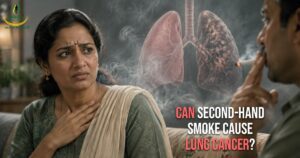
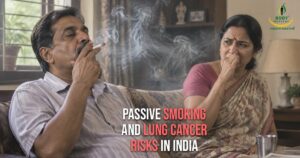
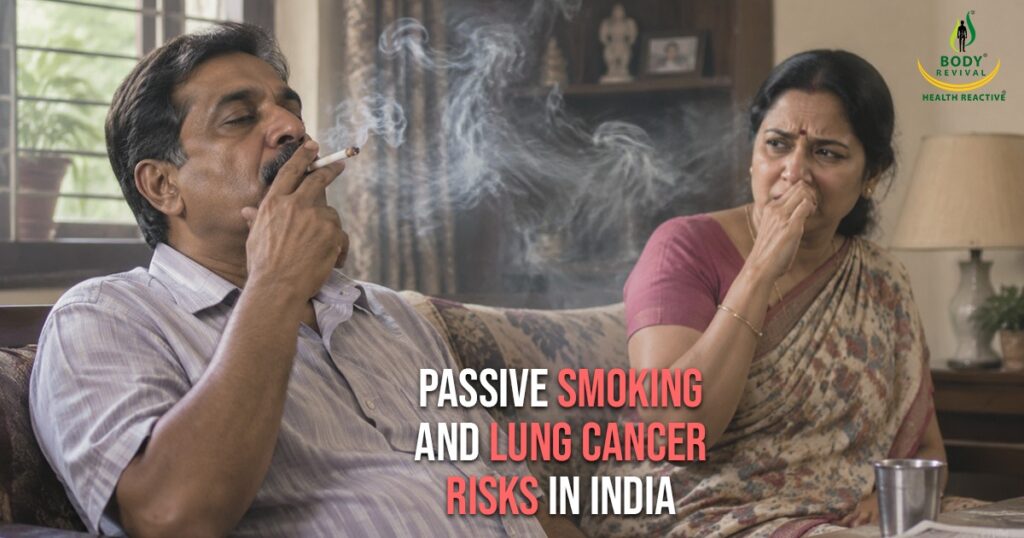
Yes. The IARC, the WHO’s cancer research agency, classes second-hand (involuntary) smoke as carcinogenic to humans, with sufficient evidence that it causes lung cancer (IARC Monograph 83). For non-smokers living with a smoker, it reports an excess lung cancer risk of the order of 20% for women and 30% for men, and a significant increase of 12 to 19% among never-smokers exposed at work.
The WHO says there is no safe level of exposure to second-hand smoke, and that it causes lung cancer and heart disease (WHO). It estimates that second-hand smoke kills more than 1.6 million non-smokers a year. India’s tobacco control programme says non-smokers exposed to second-hand smoke face a 25 to 35% higher risk of acute coronary events (NTCP FAQs). A bidi, cigarette or hookah burning in your room puts that smoke into your family’s lungs.
These are relative risks: they describe an increase on top of a small starting risk. That does not make them unimportant, and it is why reducing exposure is worthwhile for everyone at home.
How many Indian families are exposed to second-hand smoke?
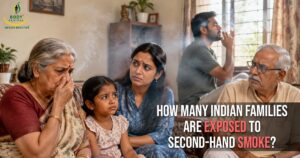
Many. GATS-2 found that more than one in three adults was exposed to smoke at home.
| Adults exposed, 2016-17 (GATS-2) | Men | Women | All adults |
| At home | 38.1% | 39.3% | 38.7% |
| At work (among those working indoors) | 32.7% | 17.9% | 30.2% |
| In public transport | 16.6% | 9.9% | 13.3% |
| In restaurants | 13.0% | 1.6% | 7.4% |
Look at the first row: only 2.0% of Indian women smoke, but 39.3% of women are exposed to smoke at home. For many women, children and older family members, the smoke does not come from a choice they made. A 2025 study in the Indian Journal of Medical Research of non-smoking young people aged 15 to 24 found that exposure at home fell from 50% to 37.6% between the two GATS rounds (2009-10 to 2016-17), which is progress, and still more than one in three. The study linked rural residence to higher exposure.
How can families reduce exposure at home?
The WHO’s position is that only 100% smoke-free environments adequately protect people from second-hand smoke (WHO). Here are practical steps. No home can promise zero risk, but each step lowers exposure.
- Make the home 100% smoke-free: no bidi, cigarette or hookah indoors, for anyone, including guests. Say it kindly and put it in as a family rule.
- Keep smoking away from children, pregnant women and older family members, and out of shared vehicles such as autos, cars and school vans.
- Do not rely on a window, a fan or another room. They can feel better, but the WHO position is that only fully smoke-free spaces protect.
- Do not smoke or light a hookah near a patient with a cough, breathing problem or any cancer.
- Ask visitors and relatives to smoke outside, away from the door and windows, or to skip it.
- Offer a better habit: a walk, tea, a glass of water or chewing a clove or cardamom for the urge. Replace the “smoke break”, do not just ban it.
- Support the smoker to quit (see below). A home is smoke-free for good when the smoker stops.
Is smoking in public places banned in India?
Yes. Section 4 of COTPA, the Cigarettes and Other Tobacco Products Act (2003), says no person shall smoke in any public place, and the fine is up to ₹200 (Tobacco Control Laws). Owners and managers of public places also have duties. Some states set stricter fines.
At work, you can ask your employer or building manager to enforce the rule, and to keep any smoking away from doorways and shared spaces. The home is not a public place, so your family’s rules matter there.
How can a bidi or hookah user quit?
Many smokers want to quit. In GATS-2, 38.5% of smokers had tried to quit in the previous year, 55.4% were planning or thinking about it, and 48.8% had been advised to quit by a health worker. Support improves your chances. Free options include:
- National Tobacco Quitline: call 1800-11-2356 (toll-free). Trained counsellors, run from the Vallabhbhai Patel Chest Institute in Delhi, give telephone counselling and follow up for a year. Open Sunday and Tuesday to Saturday, 8 am to 8 pm (NTQLS).
- Your doctor: ask about quit support and medicines. Do not start a new herbal product to quit without asking your doctor.
Slips are common and do not mean failure. Set a quit date, tell your family, remove bidis, matches and hookah equipment from the house, and call the quitline when the urge hits.
When should I see a doctor?
A cough that lasts, coughing up blood, breathlessness, chest pain, repeated chest infections or unexplained weight loss are all reasons to get checked, whether or not you smoke (NHS). These symptoms have many causes and are often not cancer, but a persistent cough needs a medical assessment. See our guides on lung cancer warning signs and coughing up blood. If you do not smoke but have lived with heavy smoke exposure, mention it to your doctor. Our guide to lung cancer in non-smokers covers other causes.
Get emergency help (ambulance 108 or 112 in India) for heavy coughing of blood, severe breathlessness or chest pain.
How does Body Revival fit in?

Prevention comes first: smoke-free homes, quitting support and early checks. For families who are already facing a cancer diagnosis, including lung cancer, Body Revival is designed as Ayurvedic supportive care alongside the oncology team’s treatment.
Body Revival is an Ayurvedic medicine developed by Health Reactive for people who want supportive care during their cancer journey (about Body Revival). It combines six plant-based ingredients: Madhu (honey), Kukarundha (Blumea lacera), Kharabuja (Cucumis melo), Lasuna (garlic), Bilva (Aegle marmelos) and Haritaki (Terminalia chebula).
The research: Body Revival is the subject of a breast cancer study registered with the Clinical Trials Registry of India (CTRI/2023/11/059465), run over 11 months (October 2023 to November 2024) with oncologists from J.B. Roy State Ayurvedic Medical College, Kolkata, according to Body Revival’s clinical trial page. It reports improved quality of life, performance status, appetite and stamina, and fewer treatment-related side effects. It was one study in a specific group of patients, and individual results vary.
How to use it well:
- Follow your doctor’s plan and keep all scans and check-ups.
- Show doctor the ingredient list and label before you start. Mention allergies (the formulation includes honey and garlic), blood thinners and every medicine you take.
- Keep the home smoke-free, and keep up meals, fluids and rest. Report any new symptom to your doctor.
Talk to Body Revival (India): Email official@bodyrevival.in, call or WhatsApp +91 9773368945, or call toll-free 1800 313 9229. Order at bodyrevival.in.
Key takeaways
- Bidi, hookah and second-hand smoke all raise lung cancer risk. None is a safe alternative to cigarettes, and no level of second-hand smoke is safe.
- Bidis are the most common smoked tobacco in India, and in one study of men in southern India, bidi-only smokers had a higher lung cancer risk than cigarette-only smokers.
- Nearly 4 in 10 Indian adults, and 39.3% of women, are exposed to smoke at home. Children and non-smoking family members share the risk.
- A fully smoke-free home is the most effective protection. Windows, fans and other rooms are not a substitute. No step is risk-free, but every cut in exposure helps.
- Free help to quit is available: National Tobacco Quitline 1800-11-2356.
- A cough that lasts or coughing up blood needs a medical check.
- For families facing a cancer diagnosis, Body Revival is Ayurvedic supportive care alongside the oncology team’s treatment.
Frequently Asked Questions (English)
1. Is bidi more harmful than a cigarette?
In a study of men in southern India, bidi-only smokers had a higher lung cancer risk than cigarette-only smokers, and the authors concluded bidi smoking seems to have a stronger carcinogenic effect. Both are dangerous, and no tobacco product is safe.
2. How many people in India smoke bidis?
About 7.7% of Indian adults, or roughly 71.8 million people, smoked bidis in 2016-17 (GATS-2). It is far more common among men (14.0%) than women (1.2%).
3. Is hookah safer than cigarettes?
No. The WHO says hookah smoking is not a safe alternative to cigarettes. Its smoke contains toxicants known to cause lung cancer, and a session can expose a person to more smoke over a longer time.
4. Does the water in a hookah filter out the harm?
No. The WHO has said that none of the accessories used with hookah, including the water, has been shown to reduce exposure to toxins.
5. Can second-hand smoke cause lung cancer?
Yes. The IARC classes second-hand smoke as a cause of lung cancer in humans. It reports an excess risk of about 20% for women and 30% for men living with a smoker.
6. Is there a safe level of second-hand smoke?
No. The WHO says there is no safe level of exposure to second-hand tobacco smoke. Reducing exposure lowers risk, but no step is risk-free.
7. How many people in India are exposed to second-hand smoke at home?
In 2016-17, 38.7% of adults were exposed at home (38.1% of men and 39.3% of women), according to GATS-2. These are the latest national figures I could access.
8. Can non-smoking women and children get lung cancer from smoke at home?
Second-hand smoke is a recognised cause of lung cancer in non-smokers. Although only 2.0% of Indian women smoke, 39.3% are exposed at home, so keeping the home smoke-free protects them directly.
9. Does opening a window or smoking in another room protect my family?
Not fully. The WHO says only 100% smoke-free environments adequately protect people. Smoking away from children is better than smoking next to them, but a smoke-free home is the goal.
10. How do I make my home smoke-free?
Agree a family rule: no bidi, cigarette or hookah indoors, for anyone. Ask guests to smoke outside, keep smoking away from children and patients, and support the smoker to quit.
11. Is smoking in public places banned in India?
Yes. Section 4 of COTPA (2003) bans smoking in public places, with a fine of up to ₹200. Some states, such as Karnataka, have stricter rules, including a hookah bar ban.
12. How can a bidi or hookah user quit?
Set a quit date, tell your family, remove bidis and hookah equipment from home, and call the National Tobacco Quitline on 1800-11-2356 for free counselling. Ask your doctor about quit support.
13. What is the National Tobacco Quitline number?
The toll-free number is 1800-11-2356 (also written 1800 112 356), run from the Vallabhbhai Patel Chest Institute in Delhi. The Health Ministry also lists 011-22901701 for mCessation.
14. When should I see a doctor about a cough?
See a doctor if a cough lasts, you cough up blood, or you have breathlessness, chest pain, repeated chest infections or unexplained weight loss. Most causes are not cancer, but they need assessment.
15. Where does Body Revival fit in?
Body Revival is an Ayurvedic medicine for supportive care in people already in cancer care, taken alongside medical treatment. Prevention, quitting tobacco and early checks come first.
16. How can I contact Body Revival?
Email official@bodyrevival.in, or call or WhatsApp +91 9819300030. Toll-free: 1800 313 9229.
FAQ (Hinglish)
1. Kya bidi cigarette se zyada nuksaandeh hai?
Dakshin Bharat ke purushon par hui ek study mein sirf bidi peene walon mein sirf cigarette peene walon se lung cancer ka khatra zyada paya gaya. Dono khatarnak hain, aur koi bhi tambaku surakshit nahi hai.
2. Bharat mein kitne log bidi peete hain?
2016-17 (GATS-2) mein lagbhag 7.7% vayask, yaani takriban 7.18 crore log bidi peete the. Purushon mein ye bahut zyada (14.0%) hai, mahilaon mein 1.2%.
3. Kya hookah cigarette se surakshit hai?
Nahi. WHO ke anusaar hookah cigarette ka surakshit vikalp nahi hai. Uske dhuen mein lung cancer karne wale zehrile tatva hote hain, aur ek session mein insaan zyada der tak zyada dhuan andar leta hai.
4. Kya hookah ka paani dhuen ke nuksaan ko chhaan deta hai?
Nahi. WHO ne kaha hai ki hookah ke saath use hone wali kisi bhi cheez, paani sahit, se zehrile tatvon ka asar kam hota nahi dikha hai.
5. Kya doosron ka dhuan (second-hand smoke) lung cancer kar sakta hai?
Haan. IARC second-hand smoke ko insaanon mein lung cancer ka kaaran maanta hai. Smoker ke saath rehne wali mahilaon mein lagbhag 20% aur purushon mein 30% zyada khatra bataya gaya hai.
6. Kya second-hand smoke ka koi surakshit star hai?
Nahi. WHO kehta hai ki doosron ke tambaku dhuen ka koi surakshit star nahi hai. Exposure kam karne se khatra ghatta hai, lekin koi bhi kadam khatre ko poori tarah khatam nahi karta.
7. Bharat mein kitne log ghar par doosron ke dhuen ke sampark mein aate hain?
GATS-2 (2016-17) ke anusaar 38.7% vayask ghar par sampark mein the (purush 38.1%, mahilaen 39.3%). Ye sabse naye rashtriya aankde hain jo mujhe mile.
8. Kya ghar par dhuen se non-smoking mahilaon aur bachchon ko lung cancer ho sakta hai?
Second-hand smoke non-smokers mein lung cancer ka maana hua kaaran hai. Bharat mein sirf 2.0% mahilaen smoke karti hain, lekin 39.3% ghar par dhuen ke sampark mein aati hain, isliye smoke-free ghar sabse seedha bachav hai.
9. Kya khidki kholne ya doosre kamre mein peene se parivaar surakshit rehta hai?
Poori tarah nahi. WHO kehta hai ki sirf 100% smoke-free jagah hi poora bachav deti hai. Bachchon se door peena unke paas peene se behtar hai, lekin lakshya smoke-free ghar hona chahiye.
10. Ghar ko smoke-free kaise banayein?
Parivaar mein niyam banayein: ghar ke andar bidi, cigarette ya hookah kisi ke liye nahi, mehmaanon ke liye bhi nahi. Mehmaanon ko bahar peene ko kahein, bachchon aur marizon se door rakhein, aur smoker ko chhodne mein madad karein.
11. Kya Bharat mein public jagahon par smoking par pabandi hai?
Haan. COTPA (2003) ki dhara 4 public jagahon par smoking par rok lagati hai, jurmana ₹200 tak. Karnataka jaise kuch rajyon mein niyam sakht hain, jismein hookah bar par pabandi bhi hai.
12. Bidi ya hookah chhodne ke liye kya karein?
Chhodne ki tarikh tay karein, parivaar ko batayein, ghar se bidi aur hookah ka saamaan hata dein, aur free counselling ke liye National Tobacco Quitline 1800-11-2356 par call karein. Doctor se bhi madad poochhein.
13. National Tobacco Quitline ka number kya hai?
Toll-free number 1800-11-2356 (1800 112 356 bhi likha jaata hai) hai, jo Delhi ke Vallabhbhai Patel Chest Institute se chalta hai. Swasthya mantralaya mCessation ke liye 011-22901701 bhi batata hai.
14. Khansi ke liye doctor ko kab dikhayein?
Agar khansi lambi chale, khoon aaye, saans phoole, seene mein dard ho, baar-baar chest infection ho ya bina wajah wazan ghate, to doctor se jaanch karwayein. Zyadatar kaaran cancer nahi hote, par jaanch zaroori hai.
15. Body Revival kahan fit hota hai?
Body Revival ek Ayurvedic dawa hai jo un logon ke liye banayi gayi hai jo pehle se cancer care mein hain, aur ye medical ilaaj ke saath, supportive care ke roop mein li jaati hai. Bachav, tambaku chhodna aur samay par jaanch pehle aate hain.
16. Body Revival se kaise sampark karein?
official@bodyrevival.in par email karein, ya +91 9819300030 par call ya WhatsApp karein. Toll-free: 1800 313 9229.
Disclaimer
This article is for general information only and is not medical advice. It does not diagnose any condition. If you have a cough that lasts, coughing up blood, breathlessness or chest pain, see a doctor. If you cough up a large amount of blood or have severe breathlessness, get emergency help immediately. No measure described here can guarantee that a person will not develop lung cancer. Body Revival is an Ayurvedic product for supportive care, intended to be used alongside, not in place of, the treatment your doctor advises. The CTRI number identifies a registered study in breast cancer and does not indicate approval.
References
- Ministry of Health and Family Welfare: Global Adult Tobacco Survey India 2016-17 (GATS-2) fact sheet
- Mbulo L, et al.: Patterns and related factors of bidi smoking in India, Tobacco Prevention & Cessation (2020)
- Tobacco smoking and chewing, alcohol drinking and lung cancer risk among men in southern India, International Journal of Cancer (2003)
- Chopra M, Arora M, et al.: Second-hand smoke exposure among non-smoking youth in India, GATS I and II, Indian Journal of Medical Research (2025)
- The Tribune: Bidi smoking behind squamous cell lung cancer in rural males, PGIMS study (24 November 2024)
- WHO FCTC: Press brief on the Ministry of Health bidi campaign
- NBC News: Hookahs may pose same risks as cigarettes (reporting a WHO statement); WHO: Fact sheet on waterpipe tobacco smoking and health (2015)
- World Health Organization: Tobacco and nicotine fact sheet; Only 100% smoke-free environments adequately protect from the dangers of second-hand smoke (2007)
- IARC: Monograph 83, involuntary smoking (2002)
- National Tobacco Control Programme: FAQs; mCessation; National Tobacco Quitline Services
- Tobacco Control Laws: India smoke-free law, duties and penalties (COTPA); IndiaLaw: Karnataka 2025 tobacco law overhaul
- ICMR-NCDIR: Tobacco free life
- NHS: Lung cancer symptoms
- Clinical Trials Registry of India: CTRI/2023/11/059465 (search the registry by this number)
- Body Revival: Clinical trial of Body Revival; About Body Revival