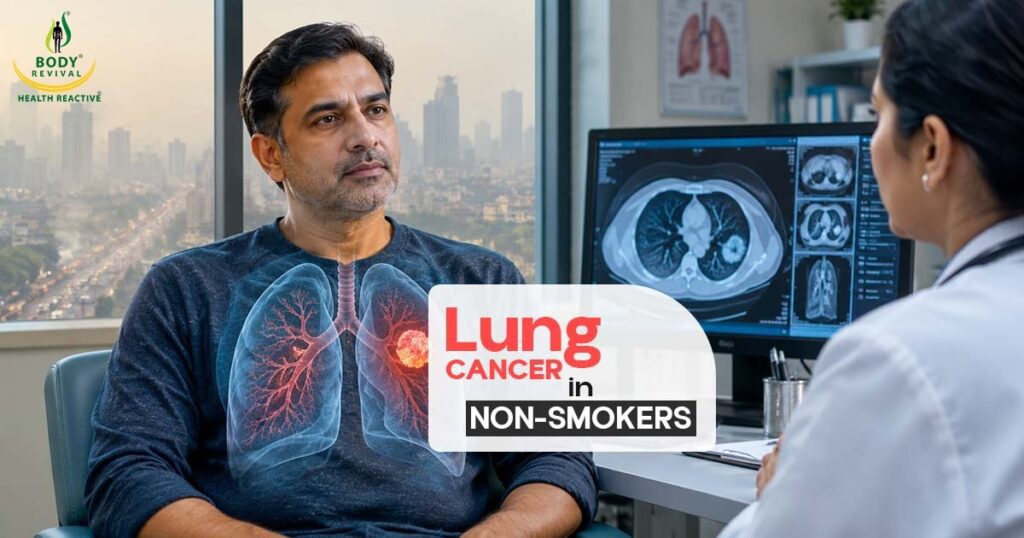
When people hear the words lung cancer, smoking is often the first risk factor that comes to mind. Smoking is indeed the leading cause, but it is not the only one.
A growing area of medical and public-health attention is lung cancer in people who have never smoked. In India, doctors and researchers are increasingly studying this group because this can also occur in people with no history of active tobacco use.
India recorded approximately 81,748 new lung cancer cases in 2022, making it the fourth most commonly diagnosed cancer in the country when both sexes are considered.
The reasons why lung cancer develops in a non-smoker can be complex. Environmental exposure, air pollution, secondhand smoke, household cooking smoke, occupational exposure, genetics and changes within lung cells can all contribute to risk.
Understanding these factors is important because not being a smoker does not completely eliminate the possibility.
Can Non-Smokers Develop Lung Cancer?
Yes. Lung cancer can develop in people who have never smoked cigarettes or other tobacco products. Research in never-smokers shows that it can have different biological and molecular characteristics from smoking-associated lung cancer. Adenocarcinoma is commonly reported in never-smokers, and certain genetic changes—including alterations involving EGFR and ALK—are seen more frequently in this population.
This does not mean that every non-smoker with lung cancer has a particular genetic mutation or environmental exposure. In many cases, the exact cause cannot be identified.
That is why lung cancer should be understood as a disease with multiple possible pathways, rather than one that is exclusively associated with smoking.
Why Is Lung Cancer in Non-Smokers Receiving More Attention in India?
Several factors have contributed to greater awareness and research interest.
1. Air Pollution
Air pollution is one of the most important environmental factors being studied in relation to lung cancer among non-smokers.
Fine particulate matter, particularly PM2.5, can penetrate deep into the respiratory system. Long-term exposure to polluted air has been associated with an increased risk of lung cancer. Recent research also continues to investigate the biological mechanisms through which air pollution may contribute to cellular damage and cancer development.
For a country with large urban populations and significant variations in air quality, this is an important area of public-health discussion.
However, air pollution should be considered one potential risk factor—not a single explanation for every case of lung cancer in a non-smoker.
2. Indoor and Biomass-Fuel Smoke
Outdoor pollution is not the only source of exposure.
In some Indian households, particularly in rural areas, cooking with biomass fuels can create indoor smoke containing particles and other substances that may affect respiratory health.
An expert statement on lung cancer screening in India identifies biomass-fuel smoke exposure, especially among rural women, along with air pollution, as important characteristics of the country’s lung-cancer risk profile.
Improving ventilation and reducing exposure to household smoke can therefore be an important part of maintaining healthier indoor air.
3. Secondhand Smoke
A person does not have to smoke themselves to be exposed to tobacco smoke.
Secondhand smoke contains numerous chemicals, including substances known to cause cancer. Long-term exposure is an established risk factor for lung cancer among non-smokers.
This makes smoke-free homes, workplaces and public environments important not only for smokers but also for people around them.
4. Occupational Exposure
Certain occupations can involve exposure to substances associated with lung cancer.
Examples include asbestos, arsenic, chromium, nickel, beryllium, cadmium and other workplace carcinogens. Such exposures can be relevant even among people who have never smoked.
For workers in industries where these substances may be present, appropriate workplace safety measures and exposure controls are important.
5. Genetic and Molecular Factors
Lung cancer is not caused only by environmental exposure.
Changes in DNA and other molecular processes can influence how cells grow and behave. Research has identified different molecular patterns in lung cancers occurring among never-smokers.
Certain actionable genetic alterations, including EGFR and ALK, are more commonly observed in never-smoker lung cancer. These findings are clinically important because molecular testing can help doctors understand the biology of a tumour and, when appropriate, identify treatment options designed for specific molecular alterations.
This is one reason modern lung-cancer care increasingly involves detailed diagnosis and, for appropriate patients, molecular profiling.
Why Are Women Often Highlighted in Non-Smoker Lung Cancer?
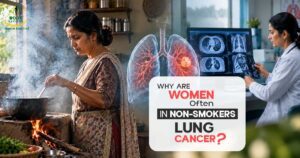
Research from several populations has found that lung cancer among never-smokers disproportionately affects women.
In India, this observation is particularly relevant when considering exposure to household cooking smoke, indoor air pollution and other environmental factors.
At the same time, lung cancer in women can affect anyone regardless of gender or smoking history. A person’s individual risk depends on multiple factors.
Symptoms Should Not Be Ignored
One challenge with lung cancer in non-smokers is that symptoms may not immediately suggest cancer.
Possible symptoms can include:
- Persistent or worsening cough
- Shortness of breath
- Chest discomfort or pain
- Unexplained weight loss
- Coughing up blood
- Recurrent respiratory infections
- Persistent tiredness
- Changes in voice
These symptoms can occur with many other respiratory conditions, so experiencing one does not automatically mean someone has lung cancer.
However, persistent or unexplained symptoms deserve medical evaluation, particularly when they continue or worsen.
Why Early Evaluation Matters
One of the challenges in India is that many lung cancer patients are diagnosed at an advanced stage. An Indian expert statement on lung-cancer screening notes that early diagnosis can improve treatment possibilities and that India currently does not have a formal population-wide lung-cancer screening programme.
Screening is not automatically recommended for every non-smoker. Decisions about testing should be based on individual risk, symptoms, age, exposure history and professional medical assessment.
For someone with persistent respiratory symptoms or significant risk factors, speaking with a qualified healthcare professional is an important first step.
Where Does Supportive Care Fit Into Lung Cancer Care?
Lung cancer care can involve different approaches depending on the individual diagnosis, stage and tumour characteristics.
Alongside cancer-directed treatment, patients may also focus on supportive care and overall wellbeing.
This can include:
- Balanced nutrition
- Appropriate physical activity
- Adequate rest
- Emotional and family support
- Stress-management practices
- Maintaining healthy routines
- Appropriate nutritional or herbal wellness products
The objective of supportive care is to keep attention on the whole person throughout the cancer journey.
Ayurvedic Medicine and Lung Cancer Support

Interest in ayurveda and plant-based wellness products has also grown among patients looking for complementary approaches to their overall health.
Products such as Body Revival® represent an interest in combining botanical ingredients with modern research and a broader supportive-care philosophy.
Body Revival is clinically tested ayurvedic liquid formulation medicine for cancer care. The company has published information about a clinical study registered with the Clinical Trials Registry of India (CTRI/2023/11/059465) and reports observations relating to quality of life, performance status and treatment-related outcomes in the study population.
For patients exploring ayurvedic medicine during cancer care, understanding the ingredients, formulation and intended role of a product is an important part of making an informed choice.
Ayurvedic products should also be discussed with the patient’s healthcare professionals, particularly when someone is receiving medicines or cancer treatment.
A More Complete Understanding of Lung Cancer
The idea that lung cancer only affects smokers is outdated.
Smoking remains the most important preventable risk factor, but lung cancer can also occur among people who have never smoked. In India, air pollution, household smoke, secondhand smoke, occupational exposure and genetic factors are among the areas receiving increasing attention.
At the same time, not every case can be attributed to one identifiable cause.
The most important message is awareness.
A non-smoker should not automatically assume that persistent respiratory symptoms are harmless. Early medical evaluation, appropriate diagnosis and individualized care remain important parts of modern lung-cancer management.
As research continues to improve our understanding of lung cancer in never-smokers, combining awareness, prevention, timely evaluation, personalized medical care and supportive wellness can help create a more comprehensive approach to the cancer journey.
Conclusion
Lung cancer is a complex disease, and its relationship with smoking is only one part of a much larger picture.
For non-smokers in India, increasing awareness of air pollution, household smoke, secondhand tobacco exposure, occupational risks and genetic factors can help create a better understanding of lung-cancer risk.
At the same time, modern cancer care continues to evolve toward a more personalized and comprehensive approach—one that considers not only the disease, but also the patient’s nutrition, wellbeing, lifestyle and quality of life.
Awareness, timely medical evaluation, personalized treatment and responsible supportive care can all have an important place in the cancer journey.
Disclaimer: This article is intended for educational and awareness purposes only and does not replace professional medical advice, diagnosis or treatment. Any herbal supplement or complementary wellness product should be discussed with a qualified healthcare professional, particularly during cancer treatment.
Frequently Asked Questions
Can a person who never smoked get lung cancer?
Yes. Lung cancer can occur in people who have never smoked. Environmental exposures, secondhand smoke, occupational factors, genetics and other biological factors may contribute.
What is the biggest cause of lung cancer in non-smokers?
There is no single cause for all non-smokers. Air pollution, secondhand smoke, occupational exposures, household smoke and genetic or molecular factors are among the factors studied.
Is air pollution linked to lung cancer?
Yes. Research has associated long-term exposure to outdoor air pollution, particularly fine particulate matter, with increased lung-cancer risk.
Are women more likely to develop lung cancer without smoking?
Studies from several populations have found that lung cancer among never-smokers disproportionately affects women. The reasons are likely multifactorial and may include environmental, genetic and biological factors.
Can Ayurvedic medicine be part of supportive cancer care?
Ayurveda wellness products may be considered as part of a broader supportive-care approach. Patients receiving cancer treatment should discuss any supplement with their healthcare professionals.
What is Body Revival?
Body Revival® is a herbal formulation developed by Health Reactive that combines botanical ingredients with a research-oriented approach to supportive wellness. The company has published information about a clinical study registered under CTRI/2023/11/059465.