| QUICK ANSWER
Coughing up blood (haemoptysis, also spelled hemoptysis) always needs a medical check. Call an ambulance or go to emergency if you cough up more than a few spots or streaks, the bleeding will not stop, or you have trouble breathing, chest pain, a fast heartbeat or dizziness. For small streaks, see a doctor the same day. Do not drive yourself. |
At A Glance
- Emergency signs: More than a few spots or streaks of blood (NHS), more than a few teaspoons (MedlinePlus), bleeding that will not stop, or blood with breathing trouble, chest or upper back pain, a very fast heartbeat or dizziness.
- Common causes: Bronchitis, pneumonia, TB and bronchiectasis. Lung cancer is a less common possible cause.
- India and TB: India accounts for about 25% of new TB cases worldwide (WHO, 2026), so doctors often test for it.
- First test: Usually a chest X-ray, often with blood and sputum tests.
- Do not: Drive yourself, take cough suppressants without medical advice, or use home remedies instead of a check.
What is coughing up blood (haemoptysis)?
Haemoptysis is the medical term for coughing up blood that comes from the lungs or airways. The blood can be a few streaks in phlegm or, less often, a larger amount. It is a symptom, not a diagnosis, and the cause ranges from a simple chest infection to conditions that need urgent treatment.
What should I do right now if I cough up blood?
Stay calm, sit upright, and arrange a medical assessment the same day. If the bleeding is heavy or you have breathing trouble, call an ambulance.
- Stay as calm as you can and sit upright rather than lying flat.
- Do not drive yourself. Ask someone to take you, or call an ambulance (in India 108 or 112).
- Note what you see: how much, what colour, when it started. If you can, keep a sample in a clean container to show the doctor.
- Take your medicines with you, including blood thinners, aspirin, herbs and supplements.
- Do not take cough suppressants unless a doctor says so. MedlinePlus warns they can block the airways.
- Get assessed today, even if the amount is small.
When is coughing up blood an emergency?
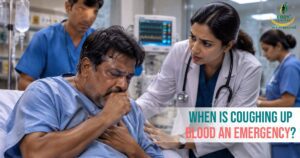
It is an emergency when you cough up more than a few spots or streaks, the bleeding will not stop, or you also have trouble breathing, chest or upper back pain, a very fast heartbeat or dizziness. In those cases, call an ambulance or go to the nearest emergency department immediately.
| What you see or feel | What to do |
| More than a few spots or streaks, bleeding that will not stop, or more than a few teaspoons | Emergency. Call an ambulance (108 or 112) or go to the nearest emergency department. |
| Any amount of blood with trouble breathing, chest or upper back pain, a very fast heartbeat, dizziness or fainting | Emergency. Same as above. |
| Blood with fever, night sweats, rapid weight loss, or blood in urine or stool | Urgent. Seek care the same day. |
| A few small spots, flecks or streaks in your phlegm | See a doctor the same day or as soon as you can. |
| Small amounts that keep coming back or last more than a week | See a doctor promptly. Do not wait for it to stop. |
Doctors define “massive” haemoptysis as roughly 100 to 1,000 mL of blood in 24 hours, or any bleeding with breathing failure or instability, and treat it as an emergency (Emergency Care BC clinician summary, 2022). You do not need to measure anything. If it seems like a lot, treat it as an emergency.
Is the blood from my lungs, my stomach or my nose?
Blood from the lungs is usually coughed up, frothy and mixed with mucus. Blood from the stomach is usually vomited and in larger amounts. Nose, mouth or throat bleeding mixes with saliva. You do not need to decide. Just tell the doctor exactly what you saw.
| Likely source | What it often looks like |
| Lungs or airways (haemoptysis) | Coughed up, usually frothy and mixed with mucus |
| Stomach or food pipe (haematemesis) | Vomited, usually in larger amounts |
| Nose, mouth, gums or throat | A nosebleed or bleeding that mixes with saliva |
Why am I coughing up blood? Common causes
The most common causes are chest infections and airway conditions, and many are treatable. Bronchitis, bronchiectasis and pneumonia as common in adults, and the NHS names TB among the usual causes.
| Cause | Notes |
| Bronchitis, pneumonia and other chest infections | Among the most common causes. Often treatable with medicine |
| Tuberculosis (TB) | Important in India. TB is treatable |
| Bronchiectasis and COPD | Long-term airway conditions |
| A blood clot in the lung | Needs urgent care. Often with sudden breathlessness or chest pain |
| Heart conditions | For example heart failure or a narrowed heart valve |
| Blood-thinning medicines | Can make bleeding more likely |
| Lung cancer | One possible cause. See our Blog – Lung cancer warning signs |
Does coughing up blood mean I have cancer?

No. Infections and airway conditions are more common causes than cancer. The NHS notes that coughing up blood can sometimes be caused by a blood clot or lung cancer, which is why every episode should be checked. Many checks find an ordinary, treatable cause. For the wider picture, read our guide to Lung cancer in non-smokers.
What should I tell the doctor?
Tell the doctor how much blood you coughed up, its colour, how often and for how long, and any other symptoms, plus your medicines and smoking history. This helps them narrow down the cause quickly.
- How much blood and what it looked like (streaks, spots, bright red, dark, frothy)
- How often and how long, and whether it is worse at night
- Other symptoms: cough, fever, night sweats, weight loss, chest pain, breathlessness
- Tobacco use (cigarettes, bidis, hookah, chewing tobacco) and any drug use
- TB: past TB, or contact with someone who has it
- Medicines: blood thinners, aspirin, painkillers, and every herb, kadha or supplement, including Body Revival
- Medical history: heart, lung, kidney or clotting conditions, recent chest infections, injury or procedures
What tests will I need?
The first test is usually a chest X-ray, often with blood tests and a sputum test. Depending on what they show, a doctor may add a CT scan or a bronchoscopy (a thin camera to look in the airways).
- Chest X-ray
- Blood tests, including a blood count and clotting tests
- Sputum tests, including for infection and TB
- CT scan if the X-ray is abnormal or the bleeding is heavy or recurs
- Bronchoscopy if more detail is needed
Treatment depends on the cause: antibiotics or TB treatment for infection, treating a clot or heart condition, adjusting blood-thinning medicines, and hospital care to control heavy bleeding.
Can home remedies stop it, or should I try them first?
No. Home remedies cannot find the cause of the bleeding, and they must never delay a medical check. Warm drinks, steam, honey, tulsi or ginger kadha and haldi milk may soothe a sore throat, but they cannot show where the blood is coming from or stop a serious cause from getting worse.
- Blood can signal something that needs treatment, such as an infection or a clot.
- Bleeding can change quickly, from a small amount to a large one.
- Waiting costs time. Days spent on remedies are days without a diagnosis.
- Assessment comes first with every product, Ayurvedic ones included. Body Revival is for supportive care and sits alongside a proper check, never in place of it.
If you want to use a home remedy for comfort, do it after you have been assessed, and tell your doctor.
How does Body Revival fit in?

Body Revival fits after assessment, never before it. Many causes of coughing up blood are treatable. If the assessment leads to cancer care, your oncology team leads the treatment, and Body Revival is designed as Ayurvedic supportive care alongside it.
Body Revival is an Ayurvedic medicine developed by Health Reactive for people who want supportive care during their cancer journey (about Body Revival). It combines plant-based ingredients like: Madhu (honey), Kukarundha (Blumea lacera), Kharabuja (Cucumis melo), Lasuna (garlic), Bilva (Aegle marmelos) and Haritaki (Terminalia chebula) and more.
The research: Body Revival is the subject of a breast cancer study registered with the Clinical Trials Registry of India (CTRI/2023/11/059465), run over 11 months (October 2023 to November 2024) with oncologists from J.B. Roy State Ayurvedic Medical College, Kolkata, according to Body Revival’s clinical trial page. It reports improved quality of life, performance status, appetite and stamina, and fewer treatment-related side effects. It was one study in a specific group of patients, and individual results vary.
How to use it well:
- Get your assessment first and follow your doctor’s plan.
- Show your oncologist the ingredient list and label before you start. Mention allergies (the formulation includes honey and garlic), blood thinners and every medicine you take.
- Keep up meals, fluids and rest, and report any new symptom, including any bleeding.
Talk to Body Revival (India): Email official@bodyrevival.in, call or WhatsApp +91 9819300030, or call toll-free 1800 313 9229. Order at body revival website.
Key takeaways
- Coughing up blood always needs a medical check. Small streaks should be seen the same day.
- It is an emergency if there are more than a few spots or streaks, will not stop, or comes with breathing trouble, chest or upper back pain, a fast heartbeat or dizziness.
- Most common causes, including bronchitis, pneumonia and TB, are treatable. Lung cancer is only one possibility.
- Tell the doctor how much, how often, other symptoms and every medicine and supplement you take.
- Do not let home remedies delay the check. Body Revival is Ayurvedic supportive care that comes after assessment.
Frequently Asked Questions (English)
1. What should I do if I cough up blood?
Stay calm, sit upright, and get a medical assessment the same day. If you cough up more than a few spots or streaks, the bleeding will not stop, or you have trouble breathing, call an ambulance (108 or 112 in India) or go to the nearest emergency department. Do not drive yourself.
2. Is coughing up blood always an emergency?
Not always, but it always needs a check. A few small streaks need a doctor the same day. It is an emergency if the amount is more than a few spots or streaks, it will not stop, or it comes with breathing trouble, chest or upper back pain, a very fast heartbeat or dizziness.
3. How much coughed-up blood is too much?
More than a few spots or streaks, or more than a few teaspoons, is treated as an emergency by the NHS, MedlinePlus and Cleveland Clinic. You do not need to measure it. If it seems like a lot, treat it as an emergency.
4. Does coughing up blood mean I have cancer?
No. Infections and airway conditions, such as bronchitis, pneumonia, TB and bronchiectasis, are more common causes. Lung cancer is one possible cause, which is why every episode should be checked.
5. Can TB cause coughing up blood?
Yes. TB is one of the usual causes and is important in India, which accounts for about 25% of new TB cases worldwide (WHO, 2026). Doctors often test the sputum for TB. TB is treatable.
6. Is a little blood in my phlegm normal?
No. Even small streaks or flecks should be checked by a doctor the same day or as soon as you can. If they keep coming back or last more than a week, see a doctor promptly.
7. What does coughing up blood look like?
It can look like spots, flecks or streaks in your phlegm, or a larger amount, bright red or darker, often frothy and mixed with mucus. You do not need to judge the cause. Tell the doctor exactly what you saw and, if you can, show a sample.
8. Do I need a check if I coughed up blood only once?
Yes. Even a single episode of a small amount should be checked the same day or as soon as you can, because the cause cannot be known without an assessment. Go to emergency if it is more than a few spots or streaks, will not stop, or comes with breathing trouble, chest pain or dizziness.
9. How can I tell if the blood is from my lungs, stomach or nose?
Blood from the lungs is usually coughed up, frothy and mixed with mucus. Blood from the stomach is usually vomited and in larger amounts. Nose, mouth or throat bleeding mixes with saliva. You do not need to decide. Tell the doctor exactly what you saw.
10. Should I take cough syrup or a cough suppressant?
Not unless a doctor says so. MedlinePlus warns that cough suppressants can block the airways when you are coughing up blood.
11. Can kadha, tulsi, honey or other home remedies stop it?
No. They may soothe a sore throat, but they cannot find the cause of the bleeding or treat a serious one. Get assessed first, and tell your doctor about anything you take.
12. What tests will the doctor do?
Usually a chest X-ray, often with blood tests (including a blood count and clotting tests) and a sputum test for infection and TB. A CT scan or bronchoscopy may follow if the X-ray is abnormal, the bleeding is heavy, or it keeps coming back.
13. What should I tell the doctor?
How much blood, its colour, how often and for how long, other symptoms (fever, night sweats, weight loss, chest pain, breathlessness), tobacco use, past TB or TB contact, your medical history, and every medicine, herb and supplement you take, including blood thinners and aspirin.
14. Where does Body Revival fit in?
Body Revival is an Ayurvedic medicine for supportive care in people already in cancer care, taken alongside medical treatment. Coughing up blood needs a medical assessment first, whatever else you take.
15. How can I contact Body Revival?
Email official@bodyrevival.in, or call or WhatsApp +91 9819300030. Toll-free: 1800 313 9229.
FAQ in Hinglish
1. Khansi mein khoon aaye to kya karein?
Shaant rahein, seedha baithein aur usi din doctor se jaanch karwayein. Agar khoon ke chhote dhabbe ya line se zyada aaye, khoon ruk na raha ho, ya saans lene mein takleef ho, to ambulance (India mein 108 ya 112) bulayein ya sabse paas ke emergency mein jaayein. Khud gaadi na chalayein.
2. Kya khansi mein khoon aana hamesha emergency hota hai?
Hamesha nahi, lekin jaanch hamesha zaroori hai. Thode se chhote dhabbon par usi din doctor ko dikhayein. Emergency tab hai jab khoon kuch dhabbon ya line se zyada ho, ruk na raha ho, ya saath mein saans mein takleef, seene ya peeth ke upar dard, tez dhadkan ya chakkar ho.
3. Kitna khoon aana khatarnaak hai?
NHS, MedlinePlus aur Cleveland Clinic ke anusaar kuch dhabbon ya line se zyada, ya kuch chammach se zyada khoon emergency maana jaata hai. Napne ki zaroorat nahi. Agar zyada lage, to emergency samjhein.
4. Kya khansi mein khoon aane ka matlab cancer hai?
Nahi. Infection aur saans ki naliyon ki bimariyan, jaise bronchitis, pneumonia, TB aur bronchiectasis, zyada aam kaaran hain. Lung cancer ek sambhav kaaran hai, isliye har baar jaanch zaroori hai.
5. Kya TB se khansi mein khoon aa sakta hai?
Haan. TB aam kaaranon mein se ek hai aur India mein khaas taur par maayne rakhta hai, kyunki duniya ke lagbhag 25% naye TB maamle India mein hain (WHO, 2026). Doctor aksar balgam ki TB jaanch karte hain. TB ka ilaaj hota hai.
6. Kya balgam mein thoda khoon aana normal hai?
Nahi. Chhote dhabbe ya line bhi usi din ya jitni jaldi ho sake doctor ko dikhayein. Agar baar-baar aayein ya ek hafte se zyada rahein, to jaldi doctor se milein.
7. Khansi mein khoon kaisa dikhta hai?
Ye balgam mein dhabbe, chhote kan ya lakeeren ho sakta hai, ya zyada maatra mein, chamkeela laal ya gehra, aksar jhaagdaar aur balgam mein mila hua. Wajah aapko tay karne ki zaroorat nahi. Doctor ko bilkul waisa hi bataiye jaisa dekha, aur ho sake to namoona dikhayein.
8. Agar sirf ek baar khoon aaya ho to bhi kya jaanch zaroori hai?
Haan. Sirf ek baar aur thoda sa bhi ho, usi din ya jitni jaldi ho sake jaanch karwayein, kyunki bina jaanch ke wajah nahi pata chalti. Agar khoon kuch dhabbon ya line se zyada ho, ruke na, ya saath mein saans mein takleef, seene mein dard ya chakkar ho, to emergency mein jaayein.
9. Kaise pata chalega ki khoon phephdon, pet ya naak se hai?
Phephdon ka khoon aam taur par khansi se aata hai, jhaagdaar aur balgam mein mila hota hai. Pet ka khoon aam taur par ulti mein aur zyada maatra mein hota hai. Naak, munh ya gale ka khoon laar mein mil jaata hai. Aapko faisla karne ki zaroorat nahi. Doctor ko bilkul waisa hi bataiye jaisa dekha.
10. Kya khansi ki syrup ya cough suppressant lena chahiye?
Jab tak doctor na kahein, nahi. MedlinePlus ke anusaar khansi mein khoon aane par cough suppressant saans ki nali ko rok sakte hain.
11. Kya kadha, tulsi, shahad ya ghar ke nuskhe se khoon ruk sakta hai?
Nahi. Ye gale ko aaram de sakte hain, lekin khoon aane ki wajah nahi dhoondh sakte aur gambhir wajah ka ilaaj nahi kar sakte. Pehle jaanch karwayein, aur jo bhi lete hain wo doctor ko bataiye.
12. Doctor kaun si jaanch karte hain?
Aam taur par chest X-ray, aksar khoon ki jaanch (blood count aur clotting) aur infection tatha TB ke liye balgam ki jaanch. X-ray mein gadbad ho, khoon zyada ho ya baar-baar aaye to CT scan ya bronchoscopy ki ja sakti hai.
13. Doctor ko kya batana chahiye?
Kitna khoon, uska rang, kitni baar aur kab se, baaki lakshan (bukhaar, raat ko paseena, wazan kam hona, seene mein dard, saans phoolna), tambaakoo ka istemaal, pehle TB ya TB marij ke sampark ki jaankari, purani bimariyan, aur har dawa, jadi-booti ya supplement, jisme blood thinner aur aspirin bhi shamil hain.
14. Body Revival kaise kaam karta hai?
Body Revival ek Ayurvedic dawa hai jo un logon ke liye banayi gayi hai jo pehle se cancer ka treatment le rahe h ya kisi or chronic disease mein hain, aur ye medical ilaaj ke saath, supportive care ke roop mein li jaati hai. Khansi mein khoon aane par pehle doctor se jaanch zaroori hai, chahe aap aur kuch bhi lete hon.
15. Body Revival se kaise sampark karein?
info@bodyrevival.in par email karein, ya +91 9829636116 par call ya WhatsApp karein. Toll-free: 1800 313 9229.
Disclaimer
This article is for general information only and is not medical advice. It does not diagnose any condition. If you are coughing up more than a small amount of blood, or have trouble breathing, chest pain, a fast heartbeat or dizziness, get emergency help immediately. Home remedies and Ayurvedic products are not a substitute for medical assessment. Body Revival is an Ayurvedic product for supportive care, intended to be used alongside, not in place of, the treatment your doctor advises, and it is not a treatment for coughing up blood. The CTRI number identifies a registered study in breast cancer and does not indicate approval.
References
- NHS: Coughing up blood; Symptoms of lung cancer
- Cleveland Clinic: Coughing up blood
- MedlinePlus: Coughing up blood
- Mayo Clinic: Coughing up blood (when to see a doctor; causes)
- Emergency Care BC: Hemoptysis: diagnosis and treatment (clinician summary, 2022)
- World Health Organization: Tuberculosis fact sheet (2026)
- Clinical Trials Registry of India: CTRI/2023/11/059465 (search the registry by this number)
- Body Revival: Clinical trial of Body Revival; About Body Revival